Category: Parental Involvement
January 26, 2010
by Nancy Rawley
Awww, does my headline say it all? I believe it does.
Have you heard about Starbase?
From their website:
STARBASE Portland is designed for students Kindergarten through 12th grade.
The goal of the STARBASE Portland Program is to raise the interest and improve the knowledge and skills of at-risk youth in math, science, and technology by exposing them to the technological environment and positive role models found on military bases and installations.
The STARBASE Portland Program curriculum provides 25 classroom contact hours of instruction spread over 5 days. All STARBASE classroom contact hours take place on the Portland Air National Guard Base or Jackson Army National Guard Armory.
PPS parent Cindy Young has heard of Starbase. I have, too. The fifth-graders at my kids’ school know about it now. You know who’s high on it? My children’s principal and, it would appear, their teachers. I am not high on it. I am wholeheartedly against it. I am against it with my whole, hippie, radical left-leaning, socialist feminist heart. We are pacifists at my house, that’s why. You think I’m cool with my kid “playing war” at a military base? Excuse me, but have we met? I’m Nancy. I do not care for war games and a whitewashed introduction to death. C’mere, so I can smack you upside the head. (I am a pacifist; I never said I don’t have a temper. My mama did not raise a fool.)
Instead of “at-risk youth,” as Starbase so patronizingly calls our students, I would like to suggest that they go for some “transparency” and say “cannon fodder,” ie…
“We need more poor kids for cannon fodder because the wars we have been fighting for… well, let me think… your parents’ entire lives, your entire life and your children’s entire lives, too, aren’t going that well.”
You know what comes to mind? That old saying:
“Join the Army; travel to strange, exotic lands; meet interesting people; and kill them.”
My daughter, “That’s horrible!”
Me, “That’s the military.”
PPS is down with military recruitment, we already knew this. And they don’t have any qualms about starting awfully young. That website, it says “kindergarten through 12th grade,” does it not? Five? Age five. Ages five through eighteen. How convenient.
Here is an article that my colleague Anne Trudeau wrote for the Southeast Examiner, Sept. 2005.
ANOTHER SIDE TO THE MILITARY RECRUITMENT STORY
September 2005 Southeast Examiner
William Ramirez was a junior at Franklin High school when he was approached by the Army recruiters who visited there regularly. Annette Pritchard, Ramirez’s aunt, holds up a photograph of nineteen year old William that was found in his belongings after he was killed in Baghdad on February 19, 2004.
“The recruiters became his best friends. They told him that they only took high school graduates. Even after he dropped out of high school, they said he could be an architect or an engineer.”
William served a year in Afghanistan and then went to Iraq. As a member of the 2nd Armored Calvary Division, William was working night patrols in the city of Baghdad. His job was to illuminate targets.
His aunt gazes at the photo of the young man wearing goggles and a helmet. “He was always so shy. We were surprised he looked straight at the camera here. But he still looks scared.”
Spurred on by William’s death, Annette is determined to present another side to the military recruiter’s promises of rewarding career opportunities. Speaking before several dozen people at an August anti-military recruiting workshop in Portland, she lists the subtle and not-so-subtle tactics the military uses to appeal to youth as young as 12 years old. Rock climbing walls at county fairs, military sponsored concerts, the Rose Festival Fleet, and military air shows are all paid for out of the military’s recruiting budget.
“They landed a military helicopter on the playing field of my son’s middle school as a reward for phone cards the students had collected for military personnel.” Annette recalls. Parents were not notified, and attendance was required. Pritchard questioned the motives of this expensive event which cost far more than the money the children raised for phone cards.
Recruiters for the military are common sights in local high schools. The No Child Left Behind Act contains a provision that requires public high schools to hand over the private contact information of students to military recruiters. By September 30, the names of thousands of Portland high schoolers will be given to the military and the private firm that is creating a database to aid in their recruitment efforts.
But students can “opt out” by filling out a form that prevents their private information from being released to the military’s list. Even students who have signed up for the military under the Delayed Entry Program can change their status by notifying the recruiting station Commander.
Members of the Portland Anti-Military Recruiting Coalition will be handing out leaflets at Franklin, Cleveland and other high schools around the city letting students know they have the right to opt out. Annette Pritchard will continue her work with Military Families Speak Out. She wants to talk to every high school student she can, to let them know that there is more to the recruiter’s pitch than meets the eye.
RESOURCES
Leave My Child Alone Coalition
Portland Anti-Military Coalition
Military Families Speak Out
The Military and Draft Counseling Project 503-238-0605
–Anne Trudeau
Rest in peace, my brother. And peace to your family. Peace, peace, peace. I will never grow tired of that word. Peace.
Do you really think that I feel like talking about private matters at my children’s school? With their teachers? Their principal? The other parents? I don’t. Sex, religion and politics are all private, and frankly, it’s no one’s business how I vote, where I donate money, or where I stand on a particular issue. It is still, I believe, a free country, and I don’t like the pressure of having to explain to everyone why I feel the way I do.
It feels like looking down the barrel of a gun to me.
OK, you want to know why we’re opting out of Starbase? I’ll tell you why again and I will say it with pride: We are pacifists at my house. I think it’s a load of crap that our government spends billions of dollars killing mamas, daddies, their babies, grandparents, neighbors, friends, entire communities, in the name of stopping terror. But we can’t seem to get anyone, locally, nationally or internationally, fed or given proper medical care. Jobs would be good. Work and food and clean water and decent healthcare would be a good start. Science, art and music in the schools would just rock, too, wouldn’t it? But that doesn’t seem to be happening, does it?
So who’s terrorizing who, bitch?
I had heard of Starbase, but for my family it came up last school year. The kids are excited — they’ve heard you get to blow things up. Like in video games. The principal is excited, too. “It’s really cool, and they get to blow up rockets.” My daughter called bullshit and said she wasn’t going. I love my girl. Here is the e-mail I sent last spring to my children’s principal and my daughter’s 4th grade teacher:
Dear Mr. — and Mr. —,
Imagine my shock to be told — not asked, but told — that my daughter and her fellow classmates will take part in five full days of Starbase next year.
1) Our country is at war. Having our children go to a military base, while our country is at war, is not a safe or wise decision. That alone is reason enough to cancel the program.
2) I am wondering, as I spend a large portion of my time this year telling my daughter, I’m sorry, but you have to take another test, yes, I know you hate tests, and No, you’re not going to flunk fourth grade if you don’t score high — I am wondering why on earth we would devote five full days of curriculum to military indoctrination? (Because that is what it is. It’s the first steps on the road to recruitment.)
3)I am wondering, at a time when we parents are being told how “stuffed” the curriculum is, how you can justify them missing five days of school?
4) I’m asking you to cancel our school’s participation in the Starbase program.
5) I am doing this because it goes against everything I am teaching my children about “lifeskills,” and “conflict resolution” and “peace and respect.” I am asking you in remembrance of my late friend, David Johnson, who was killed in Iraq. I wrote about him here:
“He was a nice guy, you would have liked him. Very easygoing. Wanted to please. He was pretty shy. His family declined to be interviewed by the Army. The governor said, “He did not die in vain.” No, he died because he signed up to be a cook and ended up working as a machine gunner. God rest his soul, and peace to his family and those who loved him.”
In case you are missing my point: You will remember, please, that our country is at war. You will remember that our country is short on soldiers and that is why the government is happy to foot the bill for field trips like these, in order to send the kids a message that the military is “fun” (math games! science! and we’ll help pay for college!).
In case you have never noticed: The government is especially fond of recruiting at schools with high poverty rates, where brown, black, and poor whites attend school. They target children who think they have no options in life besides joining the military. The government needs more cannon fodder.
You will remember America is responsible for the deaths of at least 723,206 people who have been killed in Afghanistan and Iraq. (Since the U.S. and coalition attacks, based on lowest credible estimates. Most recent update: January 25, 2009. (Edited to say: At least 849,845 people have been killed in Afghanistan and Iraq since the U.S. and coalition attacks, based on lowest credible estimate, according to numbers posted Dec. 29, 2009.)
Thus far, 4,197 Americans have died in the Iraq war.
Here is the Willamette Week story about the Winterhaven parents’ protest of Starbase.
And, from the Neighborhood Schools Alliance site.
They requested that PPS “Pull the plug on Starbase — stealth military recruiting of PPS elementary students. NSA leader Cindy Young and fellow Winterhaven parents recently testified to the School Board regarding this Department of Defense-funded program in which elementary-aged PPS students spend 5 days at a military base learning about science and technology, but also being subtly groomed for future military recruitment. This program is not mentioned on the PPS website. There has been no Board or public oversight of Starbase at any time since the program’s introduction in Portland back in 1993. NSA calls on the School Board to launch an immediate investigation into this inappropriate and possibly illegal program.”
I will bring in political allies and the media on this if needed.
Respectfully,
Nancy Rawley
(Edited to say: You can find Starbase mentioned on the PPS site now, here and there. It is described as a “science program” and the mentions are along the lines of calendar items — which schools are taking part in the program.) Last year, my daughter’s school promised that they would offer “non-military alternate programming” at the school for students who did not want to or could not participate in the Starbase program. The Oregon Peace Institute and some of the staff at Portland State University said they would be happy to lend a hand, but that didn’t get a warm response from PPS.
Now I am being told that my daughter and whoever else protests can go “sit in someone else’s classroom” for the five days their peers are playing war games. No, we’ll figure something else out, thanks.
By the way… reportedly five PPS employees are being paid by the U.S. military to “administer” the Starbase program. That money would pay for a whole lot of microscopes and science supplies, wouldn’t it? Maybe even some staff? But then the military would be short a few bodies, and we couldn’t have that.
Peace. And I mean that, with all my heart.
– Wacky Mommy
Nancy Rawley is the mother of two PPS students, and is co-publisher of PPS Equity. She blogs regularly at Wacky Mommy.
67 Comments
January 4, 2010
by Stephanie Hunter
On December 9th and 10th stakeholders invested in a wide array of integrated services in PPS gathered together to review data from the recent audit of special education services and make recommendations on next steps.
My “stake” in this is as a parent of a child with an IEP in the district and as someone that cares deeply about better outcomes for those receiving special education services.
On the first day the stakeholder’s were presented with the faces and stories of integrated services. First we watched a video about special education that featured parents, grandparents, students, and staff; this video will be linked on the PPS website.
Carole Smith and Xavier Botana spoke to the group and then we heard from Joanne Mabbot the director of Integrated Services and others within the department or the audit team. The parent/grandparent panel spoke and we were given about 3 minutes each to tell our stories.
The objective feedback I received from some in the audience was that our panel represented parents that were savvy and made the system work for them. Weeks prior to the stakeholders meeting the department acknowledged a desire for more diversity on the panel and asked for help from the parent/grandparent stakeholders.
Sheila Warren, parent union organizer, spoke about her own experiences on the video and panel and also about her efforts to include those under-represented voices. During both days I was relieved to hear from many stakeholders a deep concern for equity and a desire to bring in the voices of foster parents, parents with disabilities, low-income families, minority families, and children who live in group homes or mental health facilities. In several side conversations there was an overall commitment to finding a way to capture these stories.
During my 3 minutes on the parent panel I talked about my dilemma of choosing belonging over academics. My teacher works very hard to educate my daughter and has a great team of supports to meet her academic IEP goals. Despite this, I know in my heart my daughter needs more 1 to 1 help to meet her academic potential and her teacher has not yet learned to clone herself or grow 50 arms and 25 heads.
For now, I choose friends, meaningful activities, and natural environment learning because that is what our family has decided is most important. I told a story about how my daughter cried when I told her about advancing to 1st grade. Through her tears she could barely get out the words, “I am going to miss my friends so much.” I wish I could bottle the relief on her face when I told her that her friends go to 1st grade too.
I used this story at the meeting as a way to highlight the importance of belonging and that “loneliness is the only real disability” (a quote by Beth Mount). Since this is an opinion piece I want to be clear that I am not complaining about the choice I have made or the education my daughter is receiving.
I would love it if my daughter’s school was a student-centered technological wonderland that was set up to have universal access and honored the multiple intelligences and every teacher had training in modifying curriculum for all learners. I would be thrilled if my daughter could just have access to an ordinary education in a low enrolled PPS school!
Regardless, I have the luxury of a choice some parents of kids with IEP’s don’t have. My complaint is that I have had to engineer my experience of special education on my own with mentoring from other parents I was lucky enough to meet and learn from.
How do we teach other parents what I know on a widespread basis? How do we share with other teachers what my teacher knows about how to help kids with IEP’s be successful in general education classrooms? Why is it word of mouth and not common knowledge? What is it with what seems like a purposeful effort to keep parents in self-contained classrooms from communicating?
To be fair, one of the recommendation from the two days was for parents to opt-in to be contacted by other parents for networking and this received a lot of votes.
The student panel was wonderful and I was inspired by the teachers and staff that clearly have a vision of presumed competence in the 18-21 transition programs. The job developers and students told us about the Solar Waffle Cart on Alberta and how many of the students in transition dream of being small business owners.
There was not a hint of contrivance on the part of the transition staff and they were dreaming big right along with these kids. A young man who has had a job at Fred Meyer for 5 years told his story and thank goodness for the tissue on the table. It is amazing how much this young man has cared for others in his life and how much loss he has endured but still he has a deeper sense of gratitude than anyone I know.
We heard from a Roosevelt student who has an IEP for a learning disability and how difficult it was to get her academic needs taken seriously.
What was missing on the student panel were students with physical disabilities who cannot access neighborhood schools or common areas in schools deemed accessible. What about the students in wheelchairs that cannot go to lunch with their friends because the cafeteria only has stairs? What about the kid who has to commute 45 minutes one way in good traffic to school because his “special” classroom is across town? What about the clusters of kids with disabilities who clean, landscape, recycle, shred, and do food service for free and have it called “work experience?”
To clarify my last statement; it is not the nature of the work itself but the fact that a minority group is singled out to do this work before the age of 18 when academics should be a priority along with transition services. I know countless kids who would not be happy with me if I took this work away from them but I know a few who have asked me, “How come I have to clean up after everyone and they don’t, it’s not fair?”
The point I was able to get out on day two of the forum was that if this work experience is such a great opportunity then the general education population needs to have the equity extended to them as well to work side by side with the kids with disabilities. This may actually happen in some schools and I would love to hear about it. Not all schools use the kids in transition programs to do work in the school and find real experiences in the community for them.
We heard from a panel that included an assistant principal, counselor, special education teacher, paraeducator, and a general education teacher. I appreciated what the panel had to say and the tone was notably different than the parents and students.
The paraeducator in particular really brought it home when she talked about the day to day tasks such as being bit, having your hair pulled out, a great deal of heavy lifting, dealing with various bodily fluids on a daily basis, and changing diapers on adult sized students.
I worked in direct care for kids and adults in group homes and have done similar work as a paraeducator with the exception being I did not also have to meet IEP goals while providing this level of support. When you do this work you just care about these kids having positive outcomes and the less glamorous, dangerous, and unpleasant parts of the day are part of that.
As I have alluded already, there was a real need to get the spectrum of experience injected into this event and the employee panel kicked it up a notch. There were some wince-worthy moments as a parent listening to the panel but I had also wished for a reality check and got one.
I do wonder what the range of experiences are in teachers and how much knowledge they have of what happens in other schools or programs. When the paraeducator talked about changing diapers someone in the audience said, “EWWWW” and it broke my heart. How dare they? That is someone’s child who should be given dignity and respect despite their toileting ability.
My opinion is that cross-training and job shadows in different schools, programs, and classrooms might not be a bad idea. Better yet, administrators need to see a day in the life of a teacher in all schools and classrooms.
When I worked in group homes and a corporate administrator was visiting the expectations was that we would spend days cleaning and painting in preparation. We would purchase new clothes for the residents, furniture, and decorations for the home. During some of these corporate visits the administrator would simply walk through the home straight to the office or leave after 10 minutes and we would wonder why we bothered.
Is this what is happening in PPS when administrators visit as well? Are PPS administrators just spending 10 minutes or heading straight to the office? What would happen if they saw the real deal? Would things change or would someone get fired or transferred?
On day two of the stakeholder’s meeting we had an opportunity to look at the data from the audit and from the data create a “gallery walk” of recommendations to be voted on as a top priority or secondary priority. The recommendations are still being boiled down to account for duplicates and common themes but the current data shared with stakeholders shows that the following areas rose to the surface:
- Collaboration time among general education, special education, and specialists along with collaborative team-teaching
- System-wide curriculum for academic and behavior intervention such as RTI and positive behavior supports
- Limiting the number of building to building transitions students in special education make
- More feedback from under-represented voices
- Other topics included more training time, more opportunities for parents to connect and feel welcome, community partnerships, being assigned based on your expertise, technology, Universal Design, equity in electives and curriculum in special education (Pioneer Special Schools in particular), and adopting ODE modified diploma standards. I am barely scratching the surface in variety of responses.
One of the highlights for me out of the two days was the presentation on Universal Design given by William Macklin from the assistive technology team. In all honesty I thought his presentation was a bit heavy on the overpriced computer software for reading but overall it made me feel better as a parent that Universal Design exists in the vocabulary at PPS.
After his presentation I had a reality check moment when I asked an administrator and teacher I was talking with about ensuring that all of the schools knew about the Universal Design technology PPS already had available for teachers. The response was that if everyone knew it existed then there would not be enough for everyone to access. The other snag with assistive technology is that only students who qualify can actually use the technology. Getting qualified requires more of that educational engineering on the part of parents and teachers that are actually aware the resources exist. There has to be a better way!
The next steps are that stakeholders meet again in February to begin action planning with the facilitators and PPS. I really hope that positive steps forward are the result of this audit and stakeholder process. I am still new enough to the public education process that I can still hope while being politely irritating (insert responses about my face in the dictionary under gullible in the comments:) ) . I left the two day event feeling positive but with even more questions and reservations about what this change to Integrated Student Services is going to look like. The director of Integrated Services started a blog and has a post about the finer details of the two-day event.
This was just a summary of my take on the two day event. I would love to hear from others who attended and everyone who has a stake in this.
Question: I am part of a subcommittee with the state looking at how to improve the quality of life for children with autism in Oregon. One of the recommendations is mentoring high school kids to become autism and behavior consultants. There are not nearly enough consultants in the state and the CDC just announced the numbers have increased to 1 in 110 children having autism nationwide. What do you think about electives or focus options being offered in topics like autism and behavior analysis?
Stephanie Hunter is a behavior consultant and the parent of a student at Ockley Green. She is active in local and statewide advocacy for children and adults with disabilities, which she writes about on her blog Belonging Matters.
5 Comments
October 12, 2009
by Steve Rawley
Download audio, subscribe to the podcast, or listen here:

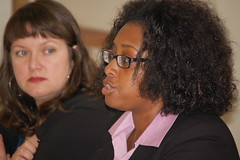
Stephannie Hunter and Shalonda Menefee
A report from the PPS Parent Union kickoff weekend, with Sheila Warren, Stephanie Hunter, Ken Libby Shalonda Menefee and more.
Steve Rawley is the father of two PPS students and is publisher and editor PPS Equity.
Comments Off
October 7, 2009
by Steve Rawley
Families unable to attend the all-day high school redesign sessions hosted by the district will have the opportunity to engage the district on the topic at the PPS Parent Union Parent Information Gathering this Saturday, October 10, from 1 to 2 p.m.
The full event runs from 11 a.m. to 3 p.m at the Curious Comedy Theater at Vanport Square, 5225 NE Martin Luther King, Jr. Blvd. There will be door prizes, Mom’s Comedy Theater skits and children’s activities. The event coincides with the anniversary celebration for the Vanport Building.
Steve Rawley is the father of two PPS students and is publisher and editor PPS Equity.
Comments Off
September 28, 2009
by Steve Rawley
Download audio, subscribe to the podcast, or listen here:

Rob Ingram:
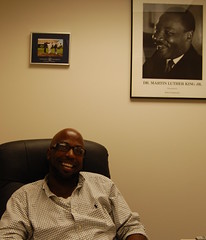
“I’m one of those guys who believes that actors and musicians and athletes are a little over-paid, and our teachers and social workers are way under-paid.” (photo by Steve Rawley)
This week in PPS, we begin a new series I’m calling “Difference Makers,” interviews with people making a difference in the lives of youth. This week, I talked with Rob Ingram, director of the City of Portland’s Office of Youth Violence Prevention. We had a broad ranging talk touching on the Million Father March, Black Men Working, the success of students involved with SEI, the PPS high school redesign, and the over-representation of black men in Oregon’s criminal justice system. I caught up with Rob at his office in Northeast Portland.
Links
Steve Rawley is the father of two PPS students and is publisher and editor PPS Equity.
Comments Off
September 16, 2009
by Steve Rawley
PPS Parent Union founder Sheila Warren is joining forces with Elijah Muhammed to present “Focus on the Black Families” this Friday, September 18 on Portland Community Media.
The first hour of the show will be broadcast on cable channel 23, and the second hour on cable channel 11.
Steve Rawley is the father of two PPS students and is publisher and editor PPS Equity.
Comments Off
June 19, 2009
by Steve Rawley
The PPS Parent Union is meeting Wednesday, June 24 from 6-8p.m., at 101 SW Main, Alaska Room (seventh floor).
From the PPS Parent Union Facebook page:
The work starts. This meeting will concentrate on a strategic plan (mission, vision, goals, objectives, intiatives, measures and targets).
We will be forming a parent advisory committee
Parent Academy committee ( Lakeitha Elliot Manager)
Student Union committee
Issues and Actions committee
Political Actions committee
Ethnic and Minority Affairs committee
Services comm.
Volunteer Program comm.
Mentoring and Partnering comm.
Steve Rawley is the father of two PPS students and is publisher and editor PPS Equity.
Comments Off
May 29, 2009
by Nicole Leggett
Dear Super Team,
I honestly feel that you missed some very clear issues that were expressed at the May 16th meeting.
You can not complete a diverse high school system redesign with out first addressing why it isn’t fair to begin with. The lines that are drawn for our schools need to cross the River. The wealth that lives in two schools should be spread around. Not only so more school have access to more involved parents, but so the students on the West side have access to a diverse community to learn in. Being able to relate to people of differing cultures is best taught young. That is a privilege that is being denied to those children now. In a 21st Century world we all need access to each other to grow to support our city, state, country, world.
Along these lines, it is past time to give neighborhood schools their neighboring enrollment back. It’s time to picture the school down the street as equivalent to the one across town. All it needs is you to make it your neighborhood school. What makes schools better is putting your children and your energy into it. It was clear around the room that neighborhood-to-neighborhood elementary transfers must end. But if honest concerns over quality of education aren’t addressed at the district level this can’t work. We thought that was the job of the K-8 reconfiguration to resolve. Where are the latest audit of K-8 course offerings for this year and next years planning?
As you have said, quality of high school course offerings has to be universal. But as the students explained, the specific educational offerings must to vary to offer specialized learning to motivated youth. So perhaps the idea is to have elementary education equalized and neighborhood focused. But to compliment this idea have an open specialty transfer process at the high school level. Where your neighborhood high school offerings are the same and if you aren’t interested in a magnet program you attend your neighborhood high school. But with the aid of publicly provided transportation, students would be free and able to choose a specialized course offering housed in another school. This would end the Kindergarten scuffle of worried parents that don’t feel comfortable with the feeder pastern of their neighborhood school.
More than anything it was expressed that the highest level of quality education should be offered to all children in all zip codes. Thank you for all of your efforts. Please continue to involve and inform the community at large as we proceed together towards a better tomorrow.
Nicole Leggett is a Peninsula K-8 Parent.
6 Comments
May 9, 2009
by Sheila Warren
The Parent’s Union is on its way. We will have our first meeting on May 13, 6:30 at 2941 NE Bryant St. Please invite anyone or any group you think wants to be a part of this landmark gathering. Let them know they get to be on the ground floor in the creation of this important and imperative group.
I will present my vision. I have talked to people who are already doing this in other cities and will be sitting at their feet for help. We need all your expert input. I am hopeful this will be a collaborative effort (sure of it). Some of you I have already asked to be the expert on certain issues since you already are.
Actions so far: We have been gathering parent’s and others’ stories of how they have been treated in our schools. Hope one or two will come to tell their story.
Groups who have committed to coming: Cascade Policy Institute, PIRC-Parental Information and Resource Center, Urban League, People Celebrating People, N-NE Black Coalition, Taskforce on the achievement gap social justice committee, Ainsworth UCC, PFLAG-Parents and Families of Lesbian and Gay Children, PTA, Special Ed. PTA, CPPS-Community and Parents for Public Schools, Community Education Partners and GrandParents raising GrandChildren.
Groups on my radar: Stand for Children (Will meet with Portland director and Stand CEO Jonah Edleman at the end of the month),
Foster Parents Association, home school Parents, homeless families, Tag parents (the program at PPS is going to be fragmented),
Special Education Groups, Head start Parents, charter school parents, Multnomah Family and community Services, DCJ, Rethinking Schools, NAYA, IRCO, CIO, APANO, Latino network, Center for Educational Excellence, Resolutions NW. We know there are many organizations, groups and parents. We will compose a list at the meeting.
For the last week I have attended 3 events that focused on Parent Involvement and collective collaboration. The time is right! We do have Parent Power!! It’s time to bring it out of the closet.
Sheila Warren is a community organizer and PPS grandparent.
4 Comments
April 9, 2009
by Stephanie Hunter
I believe that relationships are crucial to learning. Parent involvement can take many forms and honoring any and all contributions is key. While it is important to do all you can to improve education for your child you have an opportunity to help another child as well. Your child benefits, another child benefits, and you are modeling humanity and giving for your child. Parents bring different strengths and gifts to the table and PTA’s and parent leadership must foster an inclusive environment where all contributions matter big or small.
In most, if not all, classrooms there are children that are abused, neglected, ignored, or just plain lonely. Loneliness is something that cuts across all walks of life; we’ve all been there. Pervasive loneliness affects self-esteem, learning, and status. Heap on abuse, neglect, and being ignored and lack of self-determination is a given.
One teacher in a classroom of 25+ is going to have a hard time caring for all these kids as individuals. I respect that a teacher must have professional detachment for their own self-care; it is tragic what some children must endure and a teacher must have a thick skin to continue to do the work. The mission to reduce classroom overcrowding and reform education must run parallel to increased parent involvement. In a classroom of 25+ you only need one to a few self-starters to improve the environment and build relationships with all the kids. A parent in my daughter’s classroom shared with me how excited her son is when another parent volunteers. I would like to generate dialogue on the benefits of increased parental involvement, identify barriers, how do we make it inclusive and welcoming for all parents, and what can we do for those kids that are lonely, abused, neglected, and ignored?
I would like to increase the challenge by asking what can we do for the parents that don’t get involved? How can we inspire them and foster unconditional positive regard for them and show them how they can share? Some parents we can’t change but we can still help inspire their kids.
Stephanie Hunter is a behavior consultant and the parent of a student at Ockley Green. She is active in local and statewide advocacy for children and adults with disabilities, which she writes about on her blog Belonging Matters.
47 Comments